





Digital Rotational Viscometer: The Core Instrument for High-Precision Fluid Viscosity Testing in Modern Industry
 Mar 31, 2026|
 View:381
With the continuous refinement of industrial production and scientific research innovation, digital rotational viscometers, as core instruments for fluid viscosity testing, have been widely used in chemical, food, pharmaceutical, and scientific research fields. Featuring high precision, intelligence, and strong adaptability, they have broken through the limitations of traditional testing equipment, injected new momentum into industrial quality control and technological innovation, and promoted the viscosity testing industry into a new stage of digital and efficient development.
Viscosity is a key physical property of fluids that directly determines product quality, performance, and application effect. Accurate viscosity detection is essential for compliant industrial production and rigorous scientific experiments. Traditional pointer viscometers have obvious drawbacks, including large reading errors, cumbersome operation, poor data repeatability, and lack of automatic recording, which can no longer meet modern demands for testing accuracy and efficiency. The digital rotational viscometer effectively solves these industry pain points through the deep integration of digital technology and measurement technology, achieving major improvements in testing accuracy, intelligence, and convenience.
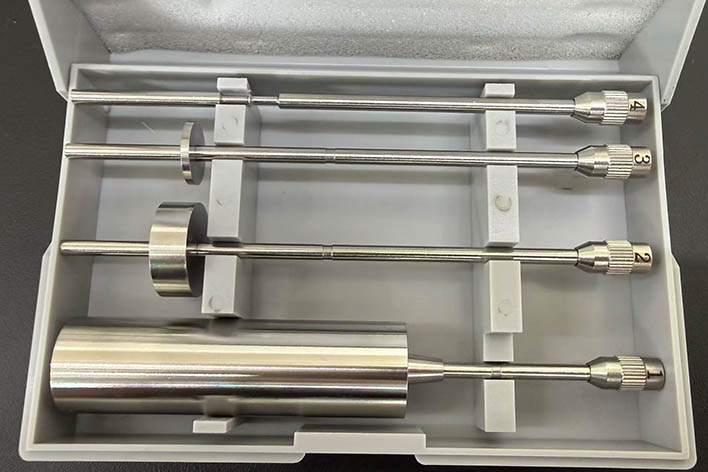
Based on precise sensing of fluid viscous resistance, the digital rotational viscometer uses a high-precision stepper motor to drive the rotor to rotate at a constant speed in the sample. A high-precision torque sensor captures the viscous resistance, and the built-in microprocessor converts the torque signal into a digital one, automatically calculating viscosity according to rotor parameters and rotation speed, with results clearly shown on a high-definition display. The whole process requires no manual conversion, fundamentally eliminating human reading errors.
In terms of core performance, its accuracy is greatly improved compared with traditional instruments. The relative standard deviation (RSD) of some models can be as low as 1.2%, and the testing error is controlled within ±1%, fully meeting national and industrial standards such as GB/T 10247-2008 and JJF 1308-2011. It supports a wide measurement range of 50–100000 mPa·s, and can test various fluids from low-viscosity solvents to high-viscosity polymer melts by switching rotors and adjusting speeds. Equipped with an intelligent constant temperature control module with precision of ±0.5℃, it effectively avoids the influence of temperature drift, ensuring stable long-term operation and batch testing.
The instrument also features outstanding intelligent and user-friendly design. Most models are equipped with high-definition touch screens, built-in operation guides and testing programs, allowing quick operation even for non-professionals. It supports automatic data recording, storage, and export, with RS232, USB and other interfaces to connect with computers and printers, enabling data traceability, report generation and batch processing, greatly reducing manual workload. The body is made of corrosion-resistant and impact-resistant materials suitable for industrial sites and laboratories, with low failure rate and fault self-diagnosis function to quickly locate problems and reduce maintenance costs.
At present, digital rotational viscometers have been widely applied in many industries. In the chemical industry, they test the viscosity of polymer melts such as polyethylene and polypropylene, optimizing production processes and ensuring product consistency. In food, they detect sauces, syrups and dairy products to control taste and safety. In pharmaceuticals, they measure drug solutions and gels to ensure qualified drug release rate. In scientific research, they provide reliable data for fluid rheology research, supporting breakthroughs in materials science and biomedicine. They also play an important role in petroleum, cosmetics, building materials and other fields.
Industry insiders pointed out that the popularization of digital rotational viscometers not only promotes the upgrading of viscosity testing technology, but also helps various industries reduce costs, improve efficiency and enhance quality. With continuous technological iteration, digital rotational viscometers will develop toward higher precision, smarter functions and more customized solutions, further expanding application scenarios and providing more reliable testing support for industrial upgrading and scientific research innovation.