As infrastructure development in China’s cold regions continues to accelerate, fiberglass-reinforced plastic (FRP/GRP) pipes have emerged as a preferred choice for municipal water supply, chemical transportation, energy pipelines, and other sectors, thanks to their lightweight, high-strength, and corrosion-resistant properties. However, low temperatures (≤-10℃), ice, snow, and frozen soil have long posed significant challenges—such as resin cold brittleness, joint seal failure, and transportation damage—hindering their widespread application in frigid areas. Recently, a specialized technical solution for the transportation and operation of FRP pipes in icy and snowy environments has been officially launched, providing an efficient answer for cold-region engineering projects.
In low-temperature conditions, the matrix resin of FRP pipes is prone to "cold brittleness," with impact toughness decreasing by 30%-50%. Collisions or 挤压 during transportation can easily cause microcracks, while slippery roads and pipe freezing in snowy weather further exacerbate transportation risks. Additionally, low temperatures reduce the elasticity of seals and slow the curing of adhesives, creating hurdles for on-site installation and joint sealing.
The newly unveiled solution addresses these pain points through material-specific innovations:
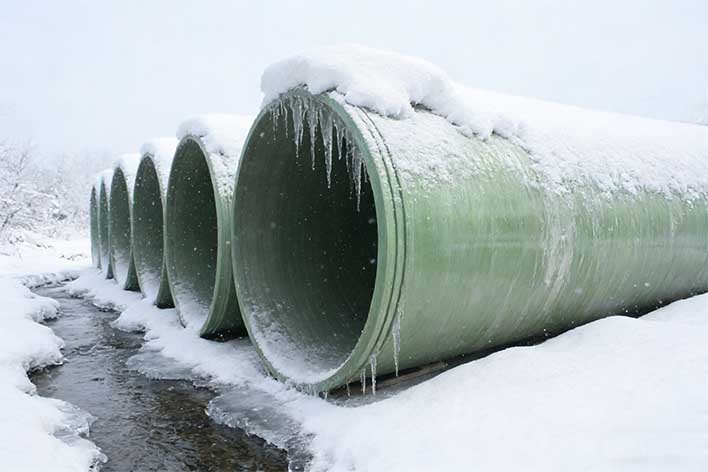
Transportation Protection: Closed vehicles combined with triple-layer protection (PE film + cold-proof felt) are adopted. Pipes are secured with wide flexible nylon straps, placed horizontally in layers with wooden spacers for cushioning, effectively preventing slipping, collision, and cold damage.
On-site Operation: Pipes are preheated in a ≥5℃ insulated shed for 24 hours before installation. Low-temperature-resistant epoxy resin pipes (withstand -40℃) and EPDM special seals are used, while localized temperature-controlled heating technology ensures reliable joint sealing and curing.
Laying & Backfilling: Direct contact with frozen soil is avoided; a medium sand buffer layer and non-frozen soil backfill are used, with exposed pipes wrapped in thermal insulation sleeves for all-round protection.
"Cold-region infrastructure demands high material weather resistance and construction safety. The technological breakthrough in FRP pipes’ low-temperature application not only solves long-standing issues in traditional pipe transportation and operation but also expands the application boundaries of composite materials in extreme environments," noted an industry technical expert. Piloted in municipal projects across Northeast and Northwest China, the solution has reduced transportation loss by over 60% and joint leakage risks by 80%, significantly improving the quality and efficiency of cold-region engineering.
With continuous advancements in composite material technology, the low-temperature performance of FRP pipes will be further optimized, injecting stronger momentum into the high-quality development of infrastructure in China’s cold regions.






 Feb 02, 2026|
 View:331