





The Hardcore Advantages of FRP Square Water Storage Tanks: A Water Storage Upgrade from Material to Application
 Feb 04, 2026|
 View:352
What happens when water storage equipment meets composite material technology? The square water storage tank, centered on Fiberglass Reinforced Plastic (FRP), is redefining the standards of water storage devices with its "material properties" — this is not a simple "container replacement, but a water storage upgrade driven by materials science.
Material Code: Why Fiberglass + Resin is the "Golden Combination"?
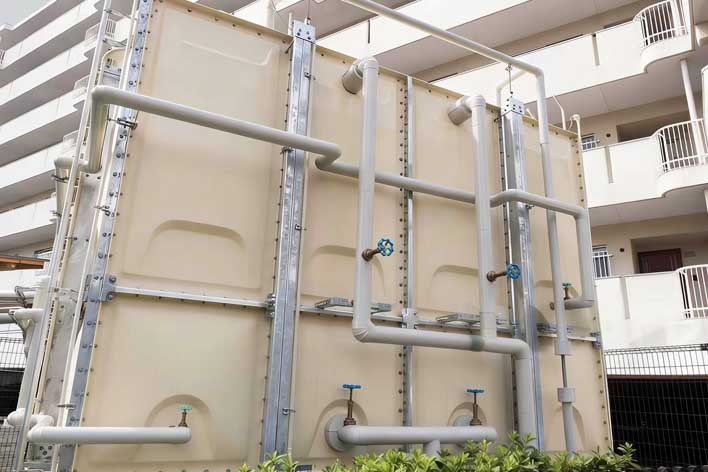
FRP is essentially a "reinforced composite material": slender fiberglass (with a diameter of only a few microns) acts as a "steel frame" to provide high strength, while unsaturated polyester resin fills the gaps like "cement" to form a dense whole. This combination endows the tank with both "lightweight" and "high strength": it is 60% lighter than metal tanks, but its compressive capacity is twice that of ordinary steel. Transportation and installation do not require heavy equipment.
Why Can It "Resist Rust and Keep Water Clean"?
A key pain point of traditional metal tanks is "corrosion" — iron reacts with water and oxygen to rust, which not only contaminates water quality but also shortens service life. In contrast, FRP has a stable molecular structure: it neither undergoes chemical reactions with acids and alkalis nor becomes brittle and aging due to UV radiation like plastic. Meanwhile, its smooth and non-porous surface prevents impurities and microorganisms in water from adhering, fundamentally reducing the problem of "scaling and water contamination" — it can even store drinking water directly.
Square + Modular Design: The "Optimal Solution" for Space Utilization
Although circular tanks have uniform stress distribution, they waste corner space — the square design is naturally compatible with the rectangular spaces of buildings and factories. More importantly, FRP tanks adopt a "modular splicing" method: each plate is produced in a standardized manner, and on-site assembly is as simple as "building blocks". From small 3-cubic-meter household water storage to large 200-cubic-meter industrial storage tanks, it can accurately match the site size, with a space utilization rate 30% higher than that of circular tanks.
From municipal water supply to agricultural irrigation, the popularization of FRP square water storage tanks is actually a microcosm of "material innovation" applied to daily scenarios — solving the "ordinary yet important" task of water storage in a more durable and flexible way.